
Bel Cobain: An MM Exclusive Interview


27 Apr 2026
Bel Cobain isn’t easy to define. Hailing from East London, her music bridges the gap between Pink Floyd’s prog, Erykah Badu’s earthy neo-soul, and the unashamedly tender otherworldliness of Greentea Peng — all while (partially) borrowing her stage surname from grunge legend Kurt. From debut single “Introverted Stoner” to 2023 EP “Radical Forgiveness”, Bel embraces spirituality, questions injustice and probes modern existence with rare vulnerability — updating hippydom for the situationship generation.
With three singles preceding her latest EP, “Kizzy”, and a slot playing new-favourite festival Cross The Tracks this May, Bel Cobain is cementing 2026 as her breakthrough year. Her return to solo projects follows three years of building hype through features with Oreglo and Coops. Primed for festival fields, dancefloors (a Nia Archives remix of “Am I Dumb” seems inevitable) or quiet introspection, Bel’s raw honesty shapes her sound, translating external chaos and internal reflection into liquid melody. Her vulnerability and versatility forge deep connections with fans, marking her as a truly exciting voice on the cusp of breaking through, much like fellow London soul-shifter Sasha Keable.
In this Mixtape Madness interview, we discuss her roots in Hackney, her influences, new EP “Kizzy”, and plans for the year ahead.
For anyone unfamiliar, who is Bel Cobain and where are you from?
I’m an artist, singer-songwriter, and painter from East London. Hackney sort of vibes.
The stage name Bel Cobain — what’s the story behind it?
Well, it’s a mix of my actual name, and I think I was just going through a phase of loving Nirvana, and it all came together when I was 16!
How would you say your Hackney childhood shaped your sound?
I think it’s just a melting pot of loads of different cultures without the stigma of mixing them all. We all used to go round each other’s houses, hang out and eat each other’s food. I think it’s my capacity to blend loads of different influences and not feel a way about it.
Were there any defining moments from this time that still influence your writing?
Maybe not my writing, but definitely when I’m thinking about exploring different genres and stuff like that. I’m not afraid to go drums-heavy or use percussion that reminds me of Bengali drums, talking drums – I’m not afraid to use that in my new stuff.
Are there any standout artistic influences still echoing today?
When I was growing up, maybe 13 or even a bit younger, I remember hearing Maverick Sabre. I remember thinking he was a beautiful representation of what it’s like to be an East Londoner and have all these cultures around you. Even as a white man, he was at the behest of being a working-class person and the police brutality that was going on – I love his honesty and his poeticism about it.
In the early years, was there a turning point where you really started to believe music could be your career?
No, I was geared up to be a doctor at St John’s Ambulance. I was very much on the trajectory of something a bit more academic, so it was a bit of a surprise.
What made you have that left-field turn and properly consider music?
When I was about 15, I had a mental health breakdown, and I just didn’t have the capacity for learning in the same way. I really needed softer, more esoteric things to kind of understand the world… That’s when I started making music and leaning into art.
Going back to your influences – they’re extremely varied, from Erykah Badu-type neo-soul to Pink Floyd psychedelia, how do you personally integrate these disparate influences into your sound?
I think the common thread is honesty and passion. As I’m starting to make more music with a rock influence in mind, what I’m pulling toward is this brutal honesty and a passionate, loving, kindred soul on a journey to work it out. Whether that is Erykah Badu going through her Motown-y neosoul, or Pink Floyd playing these crazy melodies with bare reverb. I think it’s the journey of the soul. It’s the journeying of the alone into the alone.
Your new single – “Change” – dropped last week as part of a bigger project. Can you walk us through the creative process behind it?
I wrote it with a guy called Fred Cox, who’s an incredible musician and producer. I wrote it [Change] when I didn’t have a home. I was homeless, sofa-surfing and didn’t have a base or
anchor at all. I was going to the studio, being super honest about how I felt, and I wrote this crazy thing while he [Cox] was playing guitar; we just laid it down in one take, and he started building everything over it. The process was this kind of call-and-response, where the drums are responding to my lyrics and the bass is filling in the gaps between my words. It’s definitely a dance with me and him. It’s about the importance of change and movement, and the inevitability of it.
How does this track fit into Kizzy as a wider project?
I think Kizzy is about the journey of grief, and Change is the part of the journey where there’s
acceptance.
Kizzy is six tracks long. You’ve released three singles so far – what can you tell us about the ones we haven’t heard yet?
They’re all really different. There’s some folky stuff in there. I was really inspired by Joni Mitchell, her honesty and songwriting. It ends on something super jazzy, dancey like wing jazz. Again, the genres are definitely a bit crazy, but they all tie together through the concept of grief.
Because there are so many influences on this project, can you walk us through the typical studio day on this project?
I wish my process were that linear, but the whole EP took like four years to make. Some of the tunes I’ve been writing for a while, so there isn’t really a typical studio day. I would say the process of even getting in the studio is hours of jotting little things, changing it, working it and trying it differently, like singing it in the park, the toilet, bed, singing it here and there. It’s really trying to work it before it’s in the studio, and then finding the right collaborators to make that thing come alive.
Speaking of collaborators, before this year, the last time we heard from you was a collab with Oreglo on their 2024 debut – how was that process?
That was good! The boys are super chill. I went to school with C-sé [Samuel Cesay; keys in Oreglo], but he’s a year younger than me. I think they’d been listening to my music for a while, so they were really sweet and genuinely wanted my touch on their project. I think they played it [Comet] on this weird studio on a boat? I was like, I’ll go away and sit with this for a while, I came back and wrote this thing. They had no notes; they were like ‘boom, let’s go.’ So it was pretty easy. Smooth.
Is there anything you took from working with Oreglo that has carried over into your solo material or recordings since?
What I like about Oreglo is the genre-fusing and meshing. I love that track because it felt very dubby. I definitely feel more comfortable blending stuff together because I know everyone’s on it.
We spoke about Pink Floyd, Erykah Badu, and Maverick Sabre as artists who really shaped you, is there anyone at the moment, UK or global, who’s shaping your sound sonically or thematically?
Tricky from Massive Attack is someone I’ve been trying to get into the studio with. Last year, I really took in one of his albums – Maxinquaye – there’s a normal and a deluxe version. The deluxe version is maybe twice as long and has the same songs, but done in different ways. Some have just a rhythmic click on it or just a really ambient vocal, nothing else. He’s really experimental, doesn’t give a fuck about anyone’s opinion but his own, and I’m definitely inspired by that.
What does the rest of 2026 have in store for you? Have we got more singles coming, touring or the possibility of an album?
I think I’m going to move around this project. I’m in the process of writing my next one, which is exciting because I feel like I got a lot off my chest with this one. I’d like to be more intentional about what I’m writing next time, more uplifting. I’m just touring and writing at the moment.
Finally, are there any artists you want to shout out?
Not that she needs one, but Lola Young. I appreciate her vulnerability and honesty; I feel like she gets a hard time for her art, but still prevails. She’s got her blinkers on, which I love.
Words + Interview: Keir Shields
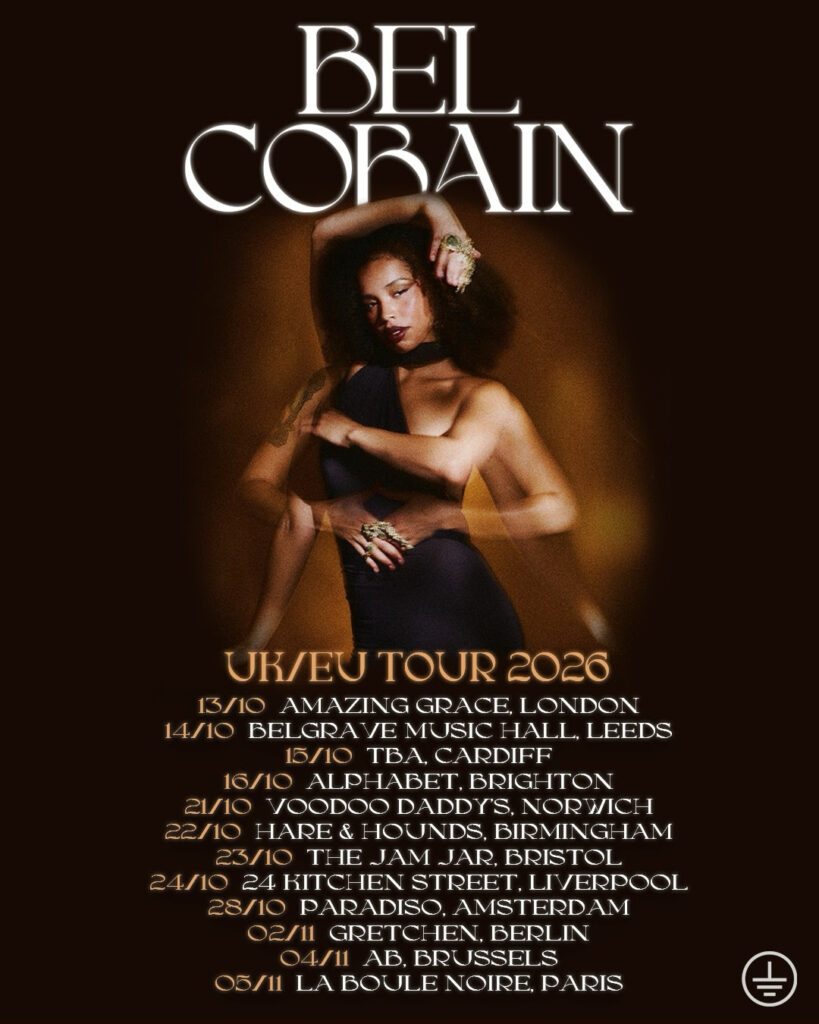
Bel Cobain tours later this year – full dates below and on sale here.
Check out Bel Cobain’s new project ‘Kizzy’ below: