


23 October 2026
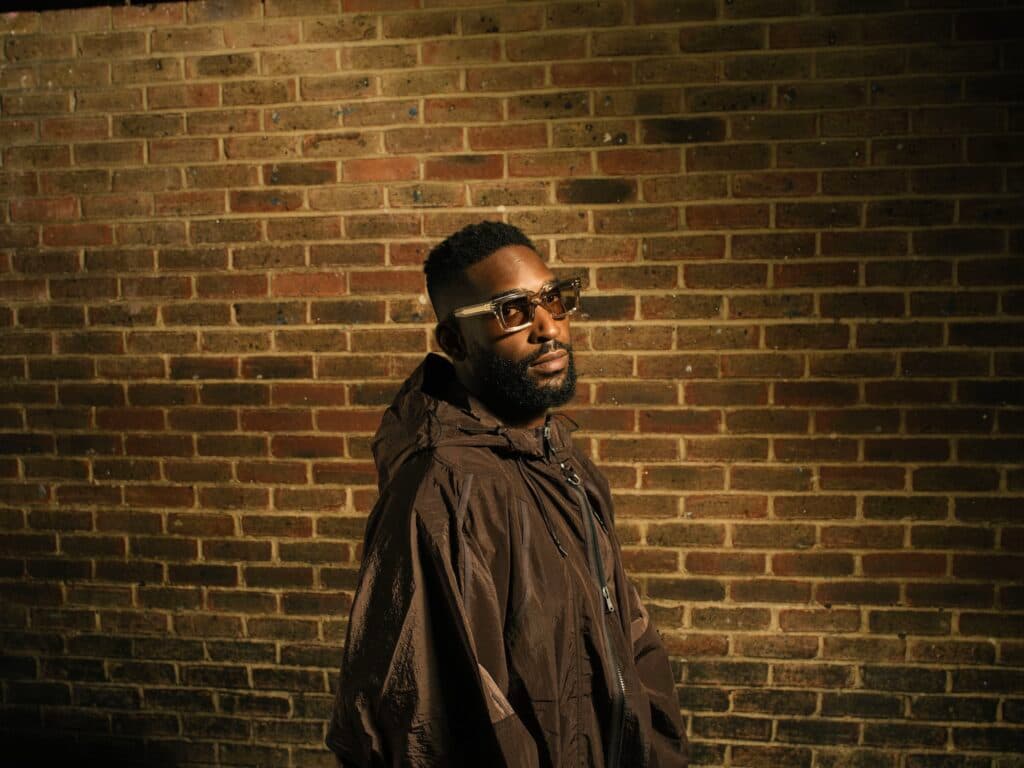
Tinie Tempah wants to talk about the club. Not necessarily the bottle-service, VIP-booth version; moreso the sweaty, low-ceilinged, night-bus-home kind that gave Britain garage, grime, dubstep and drum and bass. When Mixtape Madness meet him in a slick PR office in central London, he’s sunk into the sofa in full denim-on-denim, with his shades on throughout the conversation, looking every inch the man who once had the whole country shouting “Pass Out” at last orders.
It’s been a minute. His last album, Youth, landed in 2017, and he’s spent the years since raising two daughters, picking up a serious Brazilian jiu-jitsu habit and ending up with a five-studio building he never planned to buy. But it would be remiss to forget he was once one of Britain’s biggest pop stars, with seven UK number ones to his name, more than any other British rapper. Now he’s back with The Night’s Not Dead, a dance record that takes the long way home with baile funk, drum and bass, future garage and donk-stomp. We get into the lot.
How are you feeling? Now you have your concerts coming up tomorrow, I know you’ve been performing a bit at universities and that kind of thing, how is it getting back into that?
Honestly, it feels exciting and refreshing, because I took a super long break, so anyone who’s been following my music, I kind of just stepped out of it for like seven years.
I was just focusing on other areas of life, like kids, I started doing martial arts, Brazilian jiu-jitsu, all this different sort of stuff, so I feel like that time kind of gave me clarity and kind of put things into perspective, and I know that I’m an artist, I know I’m meant to be making music and putting it out into the world, so to get back into the mix, it’s just such a great feeling, and the love that I’ve received since I’ve decided I wanted to step back into it, it’s just been great.
Is the jiu-jitsu part of the reason you have Brazilian funk influence in the album?
A little bit. How did you know? In another lifetime, I think I would have loved to have grown up in the Portuguese world. There’s just something about whether I’m in Cape Verde, whether I’m in Portugal, whether I’m in Brazil, I just love the way that the people are and the lifestyle and how passionate the people are, and then I guess Brazilian jiu-jitsu is so all consuming and very addictive that you start eating açaí, you start eating Brazilian food, you’re around a lot of people that speak Brazilian [Portuguese] because of your professors.
If you’re lucky, you go and train in Brazil. I haven’t, but if you’re lucky, you go and train in Brazil as well. And so I think it was the influence of that that definitely made me feel like I wanted to have a bit of baile funk influence and Portuguese in there.
Tell me about why you decided to perform at unis and that kind of thing. I don’t know what else you’ve been doing there, maybe you’ve been speaking to people, but why is that?
Good question. Basically, we’re going on tour in November. We’ve got a sold-out tour around the UK already, but I just thought, I haven’t connected with, I guess, the freshers for such a long time, and I have a record, “Pass Out”, where I say “semester to semester, raving with the freshers”. I feel like when you’re 18, 19, 20, 21, it’s one of the most exciting points of your adulthood.
It’s kind of like the beginning of adulthood, and obviously now that I’m a lot older than that, you really appreciate that time more because you feel grown, but you don’t really have all the responsibilities of your typical adult. You’re learning, which can be quite tedious, but outside of that, you’re in a new city, you’re somewhere else, you’re having fun, you’re meeting new people, you’re going out, socialising.
I just wanted to stay true to that “semester to semester, raving with the freshers”, and I just thought, I’ve got a new album out, people haven’t seen me for a while, yes, I’m going on tour, but for people that might have not come across my music or people who might be discovering me for the first time, this is the perfect way to introduce myself to them.
Since you haven’t released anything for a long time, are there elements of this album that you’ve been putting together for the past 10 years in your head creatively? Or how did that work?
I think more so the past three years, I’ve been putting it together. The last album I made was nine years ago, then two years after that, we went into the pandemic. So then when we went into the pandemic, I was still writing and recording music, but with no direction. And especially the music industry, everything suffered, but I guess if you were a journalist, you could still do your work, you could get on the Zoom, do your interviews, the publication would still come out. But with music, you could release music, but there was nowhere to perform. And I feel like performing is one of the — as an artist, I think you have to see me perform to truly understand what my music does and how it makes people feel.
When that was kind of out of the picture, I kind of felt a little bit stifled creatively, like I didn’t really know what I wanted to talk about. There wasn’t anything concrete. I was just making music kind of as exercise. But then after that, the pandemic lasted about three years. So that was all a write-off; so I went into other things.
And then more recently, like three years ago, I built a new studio. We got kicked out of our old studio that we were renting. They wanted to knock it down, similar to what they’re doing to small clubs and music venues at the moment. They wanted to build high-rise apartments. So I was kind of forced into buying a studio, which was twice the size of the old studio because it was one of the only kind of ready- made studios available. And I didn’t want a big fixer-upper. I just wanted to get in and get on with work straight away. All of a sudden, I have five studios in one building. And we started to rent out some of the rooms commercially.
If people wanted to book it for sessions, [we’d say] “Just come down, we’ll record you or you can produce your music here.” And sure enough, loads of artists started coming through the door. So again, I felt myself back in that music environment, back around artists again. And it kind of reaffirmed what I was. Like, yeah, I’m just like you, this is how I like spending my time. I could sit in the studio for hours until the early hours of the morning and be perfectly content. And then I was also hearing loads of bangers coming out of the rooms as well.
So I was thinking, right, if they’re doing this, I need to be doing this. And so that’s when I started sort of gaining the confidence and crafting music that made sense to me again. And then again, post-pandemic, people’s habits started changing.
Everyone got on their health tip, wellness, run clubs, padel. I don’t know if it correlates, but we also started losing a lot of our nightclubs at the same time. So I was like, okay, cool. These nightclubs are going out of the window, but these nightclubs are part of the reason that we have garage music and we have grime music and we have dubstep and we have drum and bass. All of these incredible genres that came out of the UK that started in these small underground spots that then became commercial and then made way for superstars that came off the back of that.
Now, of course, you can be a superstar just by sitting in your house and posting enough content. I get that. But in terms of being an actual artist who can perform live, who is connecting with their audience live, I felt like those spaces were so important and they’re more than just clubs and venues. They’re more of an institution and more of a rite of passage. And so the idea of us losing them and that impacting the next generation of artists didn’t really sit right with me.
So I was like, cool, I want to talk about this, but I want to make it fun. I basically wanted it to feel like a whole night out. And instead of being negative and talking about the fact that we’re losing it, I want to celebrate what a great night out can feel like.
Is that what The Night’s Not Dead means?
That is exactly what it means. That, you know, long live the night, basically. There’s definitely a tribe of people, whether it’s like a habitual thing or whether it’s a thing that you’ve done once or twice in your life that kind of really revel in that space and really come alive in that space and learn a lot about themselves during those moments.
I always say, you know, the club is more than just going out and getting drunk. It’s where loads of people have met their partner, like their lifelong partner. It’s where loads of people have heard that song that 10, 20 years later they hear it again and it brings back all those memories of their youth.It’s where people have had to learn how to gain confidence with fashion, with the way they dress, with the way that they socialise and interact with people. So for me, it’s more of like a developing ground, like a training ground, I guess, like societally and personality-wise for an individual. I guess I just wanted to celebrate that.
And you brought UK rap into those spaces more with pop influence… What do you think of your legacy in music over the past decade?
I think I’m very proud of my legacy and I think that I’m considered as somebody who has been very experimental with their music. I think a lot of people know that I’ve come from grime music originally and I think because of social media and YouTube, it’s great because everything’s been documented, everything’s been archived. I think people will see me as somebody who’s kind of blended genres and kind of bounced from across different genres and has been able to do that successfully. I guess once my music broke through into the pop sphere, my mindset, even before that actually, was that I don’t want to just be successful as a rapper.
I don’t want to just be successful as a kid who’s come from a council estate. I want my success to be comparable to my contemporaries, whether they’re white, whether they’re Asian, whether they make pop music, whether they make folk music, indie music. I want my statistics to be comparable, if not better, than theirs.
I very much embraced the kind of pop star title or label, if you will, and obviously I’m not comparing myself to anyone, but we saw not too long ago, Drake made that song, POPSTAR, with Khaled where he got Justin Bieber to be in the video and he’s saying he’s a “pop star, not a doctor”. I think growing up, becoming a pop star, or a rock star, was the pinnacle of where you could lie or sit as a musician. Obviously, as you mature, your tastes develop, and you end up finding that niche artist that is in a very niche genre that you and only a few people know about. I think those artists are equally as amazing, but I think with my ambition and what I was going for, I achieved what I wanted to achieve. So yeah, I’m proud of it.
If we were to speak in another 10 years, what do you hope your legacy would be by then?
I hope that in 10 years people will say, “Tinie brought a lot of joy to people’s lives with his music.” “He brought loads of people together across all backgrounds, all races, all religious backgrounds. He made people want to dance, he made people want to move, he made people feel good about themselves. He brought a specific sort of energy that made people feel amped up, motivated, inspired.”
Because I really have been reflecting on that, I think just to be able to even just simply say that my music has brought joy to people’s lives and helped a generation kind of form core memories where my music is in the background is more than enough for me, I’m happy with that.
Where you came from is really important to you, but in the past 10 years you’ve amassed quite a lot of wealth; I’m sure that’s changed the way you live, especially now you have a family who you would want to treat a certain way. I know you’ve learned a lot from poverty, but do you think you’ve also learned something from wealth? How has that impacted how you create art?
Yeah, that’s a great question. I feel like I have learned a lot from the wealth that I’ve been able to attain and also be around. I’ve learned that education is super important and so I will always be grateful to my parents who immigrated from Nigeria in the 1980s for making that almost a base of what you must achieve, even though I didn’t go on to go to uni but the rest of my siblings did. But a base of what you need to move forward in your life.
I’ve learned that there’s a lot of things that growing up where I came from, we just don’t have access to the knowledge and information. Now with the internet, it’s all available but now it’s about knowing where to look and what to look for. I’ve also learned that you have to preserve wealth.
It’s one thing making a million pounds or a million dollars but if you don’t know how to use that money correctly, you could spend a million pounds in a day very easily, especially where we are now. You could walk around central London and a million pounds in a whole day would be gone very easily. So I’ve definitely learned that. And I’ve learned that wealth also doesn’t define who you are as a person. Before, I used to perceive it as a definition of a person because they would say that person was like a millionaire. If you read something, you’d say that person was a millionaire, that person was a billionaire.
And I do think that that’s a very Western way of looking at people and looking at individuals. Actually, there’s even conversations about [Aliko] Dangote, the legend himself, Africa’s richest man, the richest African man in the world. So I used to think, okay, cool, that was a milestone that you needed to attain to be defined in a certain way.
However, I think now more so that I believe that the character of the individual is so much more important than the resources that they have or what their bank balance is. It’s how you are as a person, how you treat people, what your legacy is, how much difference you make in people’s lives. And you can do that without any wealth. That’s also something I’ve learned.
I’m curious about the influences in this album, because I know a lot of it came from just protecting nightlife… I heard about the Brazilian influences in To The Floor (Vai Descendo). What else is in there?
So we have that baile funk record. It starts off as baile funk and then it actually goes into tech house. We have a bit of future garage in there that was actually inspired by a lot of the stuff I used to listen to that So Solid Crew made. And they were a crew that kind of broke through in 2001. So I think I was like 12 when they broke through and it was like dark kind of garage beats. But it ended up doing really well commercially. So I think that was inspired by them. There’s a lot of drum and bass on there as well. There’s a bit of Jersey club on the kind of like extended album. Basically what I try to do is just go through the whole spectrum of dance music and just lean into all of the genres that resonated with me when I was coming up.
I think in one way, you created real sound in the UK, even internationally. So you’re kind of modern in a way. But then also, some people would think of you as old school because they haven’t heard you since 2010. Do you consider yourself old
school?
It’s a good question. I think now I look at music differently. I look at music differently and I say that to say this. When I listen to One Love by Bob Marley, do I now, with where I’m at in my life, do I see that as old school? Not really. I just see it as like a beautiful record that is going to keep on getting played over and over again. So I see myself not as old school, but I see myself as like a legend in UK music. Just being honest and just speaking quite frankly. And I get it, I get the labels. And I get why some people may think that. Because at the end of the day, the way that we live, especially in Western society, it’s all about the new, right? It’s all about what’s next. It’s all about what’s hot, what’s up and coming. It’s all about trends. One minute everyone’s wearing these type of shoes. Next minute everyone’s wearing this.
Or you’re not on the wave, you’re not on it, you need to keep up. But at the same time, I’ve realised not to get too deep with it, but a good bottle of wine that was made in, or that was produced in 1984 is still a good bottle of wine today. And if you have the luxury to be able to experience it, you’re not necessarily saying, “oh, I want the version from 2026.”
As you kind of mature in your life, you learn to appreciate the things that were handcrafted and have been able to, and had an artisan kind of level of quality to it, and have been able to stand the test of time. And I’m quite fortunate as an artist that I have a handful of records that have been able to do that, from Pass Out to Written in the Stars to Miami 2 Ibiza, and loads more that are still being used and played over and over again. And so I think old school is kind of like a temporary term for what actually should be an artist that actually has a real legacy. Especially in a time now where half of the music we’re listening to is AI. We don’t know what’s real. We don’t know what’s not, whose vocals are real, who’s actually singing, who’s written what they’ve written, what’s auto-tuned, what’s not. It’s all just one big blur. I’ve noticed that even with generations beyond me, there’s all these events now. One of my friends has this event called R&B Only, and everyone will just go there. He’ll sell out 1,000 capacity, 2,000 capacity, and everyone’s just listening to 90s, early 2000s R&B when it was real.
It’s the best R&B…
See what I mean? It’s the best R&B, and there are R&B artists now that are phenomenal and that are killing it, but you’ve just said it.
And it goes back to what I was saying about the wine. Yes, there was a bottle that was produced in 2026, but the best wine, maybe to someone else, was made in 1991, and that’s the bottle that he or she is always sourcing and always looking for and likes the taste and the feeling of. And I believe music has that same power.
I wasn’t going to talk about AI because I feel like it takes over all the headlines, but I am curious — because that obviously didn’t exist when you were last in music — what are your thoughts on AI?
I think what’s going to happen is I think AI music eventually, because now there’s an AI label on everything, from content made with AI, etc. So I think there’s going to be an AI category, and I believe that AI music is going to be best used in restaurants, coffee shops, elevators, situations like that. And it’s also probably going to be licence-free music, so music where you don’t necessarily have to pay to access it. And then just like, let’s say, where Netflix has evolved to or where Amazon is or whatever, you can watch stuff on YouTube all day long for free, but if you want to watch the stuff that has been produced to a certain level and features a certain level of actor or actresses and has a certain level of screenwriter or scriptwriter involved in it, you have to pay for it. You have to pay to access it. I think that artists and musicians who have songs that have stood the test of time, that can pull a live crowd to come and see them play live, that have songs that make people feel things, I think they’re just going to get more and more special and more and more rare. I think someone was likening it to, let’s say like junk food, for example, which you can access kind of here, there, everywhere. You can pick up a quick, I don’t want to say any brand, but you can pick up a quick fried chicken from here or a burger from here, spend five or ten pounds, eat, and you’re good.
Or on a Saturday night or Friday night, you’re going to go to a fine dining restaurant, you’re going to sit down, you’re going to get into the ambience, you’re going to wait for the starter, then you’re going to wait 10, 20 more minutes for the main course, then you’re going to wait another 10, 20 minutes for the dessert, and you’re going to enjoy the experience with whoever you’re with or even by yourself. I think music is going to become as premium as that.
Or I saw someone performing on the street and then I actually went to the theatre to watch, I don’t know, Wicked, or I went to the theatre to watch The Lion King, which has been in theatres for decades.
Do you have a favourite song off the album?
I have a few favourite songs. One of them is definitely To The Floor, and I guess maybe it’s just how obsessed I am with, like, Brazilian jiu-jitsu and Portuguese culture at the moment, and I just like the groove of it. I feel like the tune surprises you. One of my favourite songs is also Studio Ghibli with HolyBrune. I’m a massive fan of HolyBrune at the moment. I think all the stuff that she’s done with Dayball is great, like, they’re making great funk, but they’re making it in a futuristic way, and her own stuff is just incredible as well. I really like the intro, Don’t Ask Me About Last Night, because I think, for me, it just reminds me of a way more simpler time in my life. And also, I feel like when you say dance-inspired album, that song kind of polarises you because there’s nothing dance-y about it.
So it opens actually quite classical, you know, there’s loads of strings. It’s very emotive, and I’m kind of going a little bit deep on there. And then, yeah, there’s quite a few others, but I’d say those are my three.
Why did you explore that non-dancey side in a dance album?
I just think that for my core fans, like, I wanted to make a conceptual album, but I also, I think for my core fans, I wanted to make something that let people kind of get into the inner workings of where my mind is at now. And I’m not saying that you can’t do that on a dance record, because it’s very much there, but I think with Don’t Ask Me About Last Night, which is not dance-y at all, I was able to really go deep and kind of articulate myself in a deep way without thinking about making it sound catchy or without thinking about the repetitive word that is going to become a hook that people are going to sing back. And I think that’s why I did it.
The changes from back when you were in the industry to now: what are the things that you like or don’t like, wish you had, don’t wish you had?
I’d say where social media is now; because I started coming up in the Myspace era, which is crazy to say that, I know. It’s crazy to say that, but yes, Myspace was kind of focused around music, which was quite cool, but I think now with all of the different platforms you have, the fact that you can monetise the platforms as well, so you can be an influencer on TikTok or you could be someone in theory who’s making music on TikTok and you can earn a living off of it. Do you get what I mean? Maybe not the best living, but you can earn a living. You could be on Snapchat and that’s monetised and you can make money off of that. I think it would have been cool to have that. I think there’s elements of streaming that are cool. I think if they could just find a way to remunerate the artists more fairly, in my opinion, because at the moment it’s like 0.003 dollars per stream. And so even if you generate a million streams every month for a whole year, after you’ve split everything, you’re earning about £15,000 or dollars, which I think is quite crazy for any artist to live off of. So that bit about streaming, I don’t really like and I think it needs to change. But the thing I do like about streaming is that your music is there forever to be accessed and so anything could happen. The other day one of my songs was on a Netflix show just from nowhere, some show called The Crash. And it wasn’t even one of my biggest songs,
It was a song on my third album that when I released it, I don’t even think many people even spoke about that song or really cared about it. But it was on the opening of this show called The Crash. I reckon, I believe it’s a beautiful song, but then after that the streams just spiked and it just went crazy. So I like the fact that, especially now that I have kids, my music can just be there forever. It can be easily accessed and the numbers can just compound over time and constantly generate revenue for myself, for my family. And anything can happen that can affect it, can make it go up or down. I think that that’s pretty cool.
Outside of that, I think I’m really happy that I had the live venues, that I was able to go up and down the country and perform in, do my 10,000 hours, get cheered, get booed, perform in front of 200 people, perform in front of 10 people and have to do it. I think that definitely helped me get thick skin as an artist and helped me build my confidence as an artist. So I’m sad that we are losing the venues in this day and age. And I hope that hopefully this album can inspire people to acknowledge how important these spaces are and to hopefully bring some of these spaces back.
What should we expect from you in the future? Or do you not know? Are you thinking you’re going to come out with some more albums the next few years?
I think now I’m in a place, like, I recently watched a film, well, it’s a while back now, but I watched a film on Bob Dylan’s life, and I think it was played by Timothée Chalamet, I think. And at the end, they were like, Bob Dylan produced 55 albums and sold this many, blah, blah, blah. And so I guess, I don’t know, I think when you start rapping as a kid, you kind of have in your mind that rap is a young man’s sport and you’re only meant to rap to a certain point, to the point where you’re no longer meant to do this. However, I have a totally different perspective on this now. I think ultimately I’m an artist and I rap, but I also make music in loads of different other ways as well. And I’m just going to continue to do that. That’s the thing that I do and I love doing the most. And the thing that I do that also, outside of my immediate family, brings people joy. I feel like I’m making a positive impact in the world when I make music and I release music and people receive it well.
So why would I stop doing that? Until people say to me, we don’t want to hear any more of your music – why should I stop?
Words + interview: India Das-Brown