


23 July 2026
In a culture engulfed by late-stage capitalism, it seems that recording and precision of reproduction nearly defines our lives. The very ways we ingest art are consumed by this ideology. 8K image, lossless audio, and the minutia of difference between an authentic fashion piece and a fake all speak to this zeitgeist. Nolan’s championing of 70mm film’s visual clarity is a manifest truth of this idea too.
Social media can be understood to be a democratised embodiment of recording and reproduction’s pervasiveness, enforcing people to record and distribute their experiences just to prove they have experienced them. This pressure is so prevalent that ‘no-phone’ policies in raves, clubs, and gigs are becoming increasingly commonplace. Think about how crazy that is – venues must ban recording so that the pressure to share does not usurp the enjoyment of the moment.
Although Nolan’s sleek and moody visual language is exceptionally modern, the source material for his latest endeavour has been dated to around 600 BC, with the oldest surviving fragment of its text dated to approximately 300 BC. The consensus amongst Homerian scholars is that The Odyssey was, at least at first, passed down orally. This means that it was distributed (sometimes passed down generations) via word of mouth – without being recorded. This practice means that each time the poem was told, it was done so differently. This seems incongruous with our epoch’s infinite chase of identical replication.
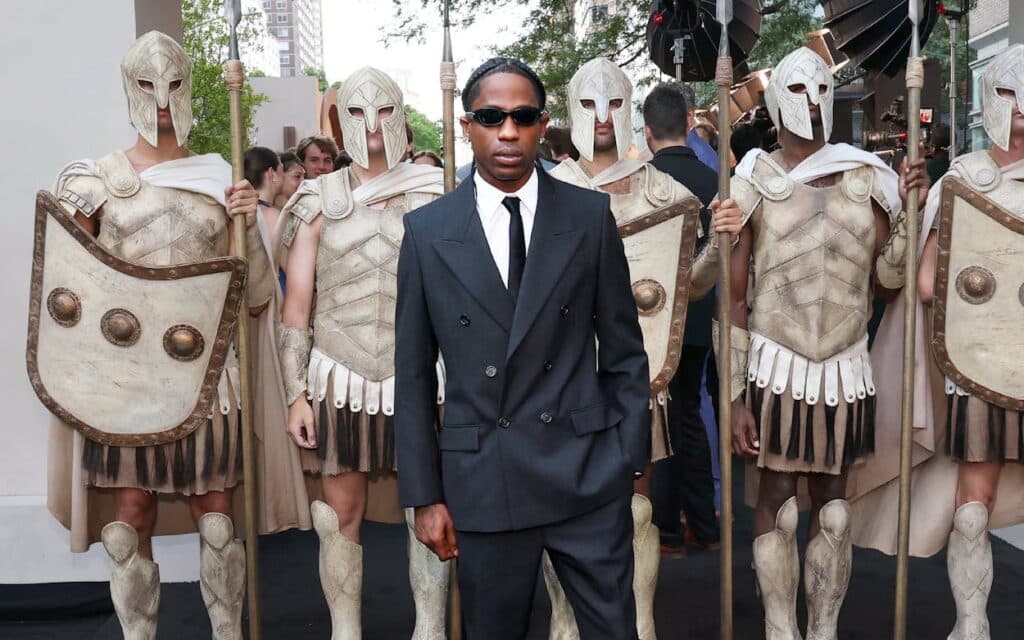
Despite the gulf in time between Homer and Nolan’s lifetimes, there exists transcending parallels between The Odyssey and the present day. Nolan seems to be very aware of this. His casting of Travis Scott as the bard who tells Odysseus’ story is an attempt to highlight an aspect of this. In an interview with Access Hollywood, Nolan says: “I cast him as I wanted to nod towards the idea that this story has been handed down through oral poetry, which is analogous to rap”.
Travis may improvise his bars before recording as part of his compositional process, but the very crystallization of his lyrics through their capture
But can we really say contemporary hip-hop is the 21st century equivalent of ancient oral poetry? The dominant way we engage with commercially successful artists such as Travis is through recordings. Even with the evanescence of a live show, the performances are rehearsed and performed more or less identically each night, and the rising of an ocean of phones at these kinds of gigs lays the attendees imperative to record bare.
Choosing Travis Scott over so many other commercial rappers with much more of a penchant for lyricism also seems strange. Take 2023’s Utopia for example. Although it is a truly vivid sonic journey through the afrofuturist world he constructs, Travis miraculously manages to spit zero memorable bars and speak nothing of note. Travis is a musical genius, but a wordsmith, poet, penman; he is not.
That is not even necessarily a criticism, though. I love Travis’s music. His brand of cosmically psychedelic production is not only masterful but is embryonic of rage rap’s focus on digital maximalism. Playboi Carti, Yeat, and Ken Carson may not sound the way they do, may not even exist, if Travis’ discography were to be wiped from time and space. The lack of focus on lyricism is also a trend with these aforementioned artists too; obscuring their bars through delay, auto-tune, pitch-shifting, and reverb to the point of unintelligibility. The chokehold these artists have on gen-z is unparalleled. So, who cares if they (or Travis) aren’t using profound metaphors and elaborate rhyme schemes?
Regardless of Travis’ focus on sonics over penmanship, the very fact streamed music is always an identical reproduction each time means it is an artform that is, in its very essence, formally antithetical to the variation and transience of The Odyssey’s initially oral dissemination. Modern-day hip-hop fits more neatly into Walter Ong’s conception of “post-literate orality” from Orality and Literacy, where oral traditions are revised and reconstituted within the context of modern music’s technological advancement.
But what is ancient formulaic oral poetry’s contemporary musical parallel? In Black Noise, Tricia Rose notes that the primordial cousin of rapping was prison toasting, a form of chanting that was improvisatory, braggadocios, and rhythmic. Toasting has sometimes said to be Jamaican in origin. Yet, legendary Jamaican reggae and ska producer Coxsone Dodd says he brought toasting back from the US and used it over instrumentals.
Toasts from the mid-twentieth century that were never recorded, can certainly be considered oral formulaic poetry. Improvisatory toasting DJs at sound-system clashes are also oral poets. Toasts were also sometimes semi or totally improvised, which aligns with the practical reality of vocalizing long poetic narratives in ancient times, since performers memorized certain lines as fixed points to then improvise off from. I also see parallels in grime raves, particularly early ones that were not recorded. MCs have adlibs that sometimes become their lyrical signature that are used as jumping off points to then spit further bars. Examples of this include Skepta’s “Go on then, go on then”, JME’s “well, well, well”, or D Double E’s “ooo, ooo”.
With the title of this essay, I am admittedly being contrary and controversial. I really do respect and admire that Nolan is paying homage to the lineage and historical compositional philosophy of these artforms. Travis has worked with Nolan before and by the very nature of Hollywood today, someone relevant to the mainstream is always going to be cast over someone who is not. But my main point is, oral cultures have nearly died in the West, which is maybe a sad thing. Yet, in, for example, African folk music, the orality of its distribution is still very much preserved.
But modern rap’s shedding of its orality, specifically because of its ingestion into the capitalist system and the online attention economy, means that the bard would have been better suited to be played by an improvising reggae toaster, a grime MC, a Malawian ulimba player, or a free jazz performer who believes recording invalidates the fundamental transience of their art. There is a beauty in the ephemerality of these styles. I ask the question, by recording and reproducing everything do we not, in fact, lose something too?
Words by Charlie Edmondson