


17 July 2026
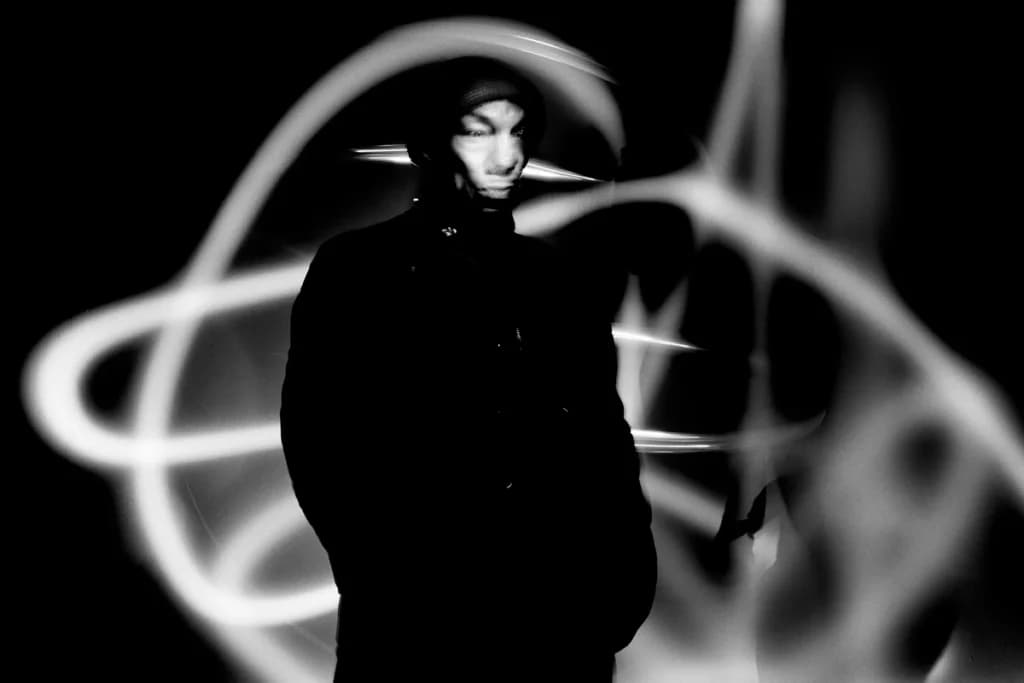
The word ‘genre-defying’ seems to get thrown around the second an album errs on the side of experimentalism, yet Tricky is one of the rare artists who has consistently earned the adjective. 30 years since the indefinable ‘Maxinquaye’, Tricky has built his career on melding ominous trip-hop, rock, and any genre he chooses into music that feels like replaying your worst memories at midnight. Yet with ‘Different When It’s Silent’ – his first project under the ‘Tricky’ moniker in six years – the producer has created a 90s-rock homage honouring the other side of the decade where he made his name.
Opening with the marching ‘I Still See Me There’, the pitched-down bass notes honour Chopin’s ‘Funeral March’; Mitch Sanders’ falsetto of ‘I still see me there/with you’ immediately strikes, as Tricky’s whispers form an inner monologue. An ominous descent, ‘I’m Yours’, keeps the same brooding intensity, with a kick-snare rhythm matching distressed synth and strings before deepening our fall with an abrupt slam of stormy guitar and a chorus of ‘I’m yours/you’re mine.’
Perhaps unfairly pigeonholed as a ‘Trip-Hop’ producer, Tricky’s latest record is at times closer in spirit to 1998’s ‘Angels with Dirty Faces’, leaning into industrial with the droning synth and aggressively fuzzed guitar on ‘I Tried.’ The sustained organ adds a sense of religious doom on ‘Cannon Fodder’, before thunderous guitar bursts through. However, Tricky’s true trip-hop roots are still peppered across the runtime; with bass synth as a foundation, ‘Be Still In The Pain’ is resplendent in the boom-bap of Massive Attack, down to Run Red Rambo’s verses and Tricky’s slurred reverb-drenched sprechgesang. Leaning further into hip-hop, the ominous orchestral feel of ‘Radana’ introduces a bass-driven beat and bars from Dwaine Brown that wouldn’t be out of place on a Giggs track.

Despite being known for his sampling and blending of disparate elements, Tricky seems less interested in creating distressed worlds from samples of other artists’ tracks and more in taking us into the pain he’s feeling. There’s an unexpected foray into hazy dream rock on ‘Paris Maybe’, and a staccato violin-and-drum machine-laden cover of Dope Lemon’s ‘Marinade.’ While ‘Paris Maybe’ lands as a despondent highlight, ‘Marinade’ is a misfire, conveying the least feeling on an otherwise soul-baring project. Instead, it feels like the obligatory throwback to his ‘Maxinquaye’ days, warping tracks into uncanny valley recognition.
As the album progresses, arrangements strip down – ‘Piano’ feels like a standout moment of just a looping piano line, and angelic vocals from Samantha Rowe backing Mitch Sanders’ falsetto. With minimalist lyrics cutting through felted instrumentation, Sanders’ delivery of ‘I got so close/close enough to lose’ feels grief-stricken and broken. Jarringly, the detour into vocoded Americana stomp of ‘Frontier Town’ sounds like the introduction to a straight-to-streaming series, and feels like it’s on the wrong album. The simplistic devastation returns with ‘Hengrove Blues’, relying on a repeated two-chord downstroke of acoustic guitar and a light synth presence. Sanders’ voice is never more impactful than here, as all pretences of bombastic production are stripped down to serve the repeated lyric of ‘I fade away.’

While emotionally bruising, there’s a sense of procession on Tricky’s 15th album as he works through grief in a stream-of-consciousness. Following up six years after ‘Fall To Pieces’ and seven years after his daughter’s untimely passing, Tricky takes the Nick Cave route, with large chunks of ‘Different When It’s Silent’ eerily similar to his despairing ‘Skeleton Tree’ in their spaciousness. The vitality of this record comes from the fact that it doesn’t give answers, nor seek to; it is the sound of a man reckoning with loss, stripping the at-times ominous production down to emphasise his pain.
Ending on a return to maximalism with the wobbling electronica of ‘Out of Place’ seems like an error, but Tricky’s strikingly mixed vocal cuts through a jump-scaring jolt of drums for lyrics of ‘Now I’m swimming/I’m moving through water/And I’m singing /I sing for my daughter.’ With the only female feature on the album being Marta on this track, Tricky ends with a statement of resilience on a cathartic project that, despite some missteps that feel lifted from a different project, takes you inside grief rather than processing it.
Rating: 8/10
Words by Keir Shields